

How To Make Legal Technology Work For You
This article is inspired by the recent Law Firm Ambition with Andy Poole, and speakers Jane Pritchard, Paul Sams and David Baskerville.
Legal technology continues to grow. Law firms are no longer looking for all-in-one systems, they may have been using 10 years ago but are now needing tech that genuinely supports their people, processes, and clients. Law Firm Ambition’s recent “Law Firm of Tomorrow: A strategic overview of legal technology” webinar explored how law firms can adopt technology strategically to achieve their objectives. Here’s what we learned.
Legal Tech Today: Adoption and Challenges
AI is now a key part of legal operations with over 90% of law firms using it in some form and many planning to increase adoption in the near future. Yet, despite this widespread adoption, legal tech is in a state of flux.
The old model of a single all in one platform that handled case management, finance and document management. Firms are increasingly looking for targeted, specialist solutions that address specific challenges, rather than forcing all processes into a single system. While this allows for more tailored and efficient workflows, it also introduces new challenges: connecting different platforms can be tricky and without careful planning, data can become fragmented across systems.
At the same time, vendors frequently overpromise. Systems may be marketed as innovative or transformative but in reality, they might simply be legacy technology with a refreshed interface or minor upgrades. Services can be inconsistent, with support levels varying dramatically between providers. Consolidation in the PMS market has further reduced choice, leaving firms with fewer vendors but an increasing array of add-ons and optional modules to navigate.
What’s Driving Law Firms to Invest in Technology?
When 200 webinar attendees were asked “What’s the real driver behind your interest in legal technology right now?” the responses highlighted a mix of operational pressures and forward-looking ambitions.

Nearly half of respondents said their current systems are creaking and holding them back, pointing to the very real frustration that outdated, or poorly integrated technology can create. More than a quarter cited client expectations for a slick, digital experience, reflecting how the pandemic has permanently shifted how clients interact with their law firms, from document access to communication and service delivery. A smaller, but still significant, portion of firms, 10%, felt pressure to keep up with faster competitors, acknowledging that speed and responsiveness are now key differentiators in the legal market.
These responses paint a clear picture: law firms are not chasing technology for its own sake. They are looking for tools that solve practical challenges, enhance client experience, improve efficiency, and position them competitively for the years ahead.
Start with the Problem, Not the Product
One of the most important messages from the webinar was clear: don’t buy shiny software without first defining the problem you’re trying to solve. It’s all too easy to be seduced by the latest AI tool or the newest all-in-one platform, but technology alone cannot fix underlying business challenges. Start by identifying the specific issue your firm wants to address. Are you aiming to improve efficiency, strengthen compliance, enhance the client experience, or gain better insights from your data? Understanding this upfront ensures that any investment is purposeful rather than reactive.
Equally important is resisting the temptation to replace existing systems with like-for-like alternatives simply because they’re familiar. Just upgrading a familiar tool doesn’t guarantee better outcomes, it may simply replicate the same inefficiencies in a new package. Instead, take a step back and ask what success really looks like for your firm, then explore the solutions that help you achieve it.
When evaluating the different options available, go beyond marketing claims. Ask detailed, practical questions about what their solution can and cannot deliver. Understand the limits of integration, the level of automation, reporting capabilities, and the true return on investment. Request proof of concept and documented commitments rather than relying on verbal assurances, which often fall short six months down the line.
A common pitfall highlighted in the session is adopting technology without properly embedding it into your firm’s people and processes. Even the most advanced tool will fail to deliver real value if staff aren’t trained, workflows aren’t updated, and responsibilities aren’t clearly defined. Successful implementation requires alignment across three key areas: the technology itself, the processes it supports, and the people using it. When all three are connected, your investment translates into tangible benefits, faster operations, improved accuracy, and a better experience for both clients and lawyers.
Integration: The Key to Success
Modern law firms rarely rely on a single platform to run their operations. Instead, they operate across multiple systems (case management, document management, finance, time recording, client portals), and increasingly AI-powered tools. In this situation, integration becomes critical. It’s not just about connecting systems; it’s about ensuring that data flows smoothly, processes are seamless, and staff can work efficiently without jumping between incompatible platforms.
Integration can take several forms, each with its own benefits and limitations.
APIs are perhaps the most familiar approach. They expose selected functionality from one system to another and can trigger actions across platforms. For example, updating a client matter in the case management system might automatically update corresponding records in billing or document management. APIs can create powerful workflows, but it’s important to understand that the data exchanged is limited to what the vendor chooses to expose. This means some insights or functionality might not transfer as you expect.
Data imports are a simpler, controlled method. They allow bulk uploads or regular updates, such as payroll or client records, from one system to another. While highly reliable for specific tasks, data imports don’t provide real-time integration and aren’t sufficient to replicate more complex workflows.
Direct access was historically used to create deeper integration, allowing firms to make system-level changes that automated processes and enabled custom reporting. However, this approach is increasingly rare because it can be fragile and challenging to maintain when software is updated. While it can unlock powerful efficiencies, it requires careful management and technical expertise.
It is important to remember that integration is more than a technical connection. It’s the backbone of efficiency. Without it, even the most sophisticated legal tech tools can become isolated, creating duplicated work, errors, and frustration. Law firms must understand not just whether their systems can talk to each other, but how well that integration supports their workflows, enables accurate data insights, and ultimately contributes to client service and operational efficiency.
Common Mistakes in Implementing Technology
Webinar attendees were asked: “Which of these causes the most damage to tech projects in real life?” The responses highlight the real-world challenges firms face when implementing new systems:

43% – Falling for vendors overpromising and underdelivering
Many law firms are drawn to flashy demos, marketing claims, and the promise of revolutionary efficiency from PMS’s. Yet without verifying these claims against the firm’s actual workflows and requirements, disappointment can follow. Features may not work as advertised or require significant manual effort to replicate the promised benefits.
17% – Integration works initially but then fails
Even a PMS that appears seamless during testing can encounter issues once in production. Updates, conflicting platforms, or incomplete API functionality can disrupt workflows, leaving teams frustrated and processes fragmented.
15% – Buying software without defining the problem
Without a clear understanding of the pain points or desired outcomes, firms risk investing in tools that don’t solve the core issues. Even high-tech solutions fail if they aren’t aligned to specific operational or strategic needs.
15% – Partners resisting change
Organisational buy-in is critical. Even the best technology can flounder if key stakeholders are reluctant to adapt. Resistance often stems from comfort with legacy systems, scepticism about ROI, or unclear communication of benefits.
7% – No one owning the project
Without a dedicated project owner, initiatives lack focus. Decisions can stall, training can be inconsistent, and accountability disappears, undermining adoption and long-term success.
Other common pitfalls surfaced during the discussion:
- Setting expectations too high: Assuming a system will solve all problems instantly can lead to disappointment and lost confidence.
- Underestimating project scale: Large PMS or document management projects often take months, sometimes a year, to fully implement. Firms must plan resources and timelines realistically.
- Ignoring data migration challenges: Legacy data must be carefully mapped, cleansed, and imported. Failing to do so risks errors, incomplete records, or lost information.
- Neglecting security and exit strategies: Due diligence on new PMS vendor security, data access, and contractual exit clauses is essential. Without it, firms face the risk of breaches, data loss, or prohibitive costs if they need to change platforms.
The message is clear: successful tech projects depend on clarity, preparation, and active management. Firms that take the time to define the problem, plan resources, and ensure buy-in are far more likely to see tangible returns from their investments.
What Technology Delivers Value in Law Firms?
Another poll asked: “If you had to justify your current legal tech stack tomorrow, which area would you defend first?”
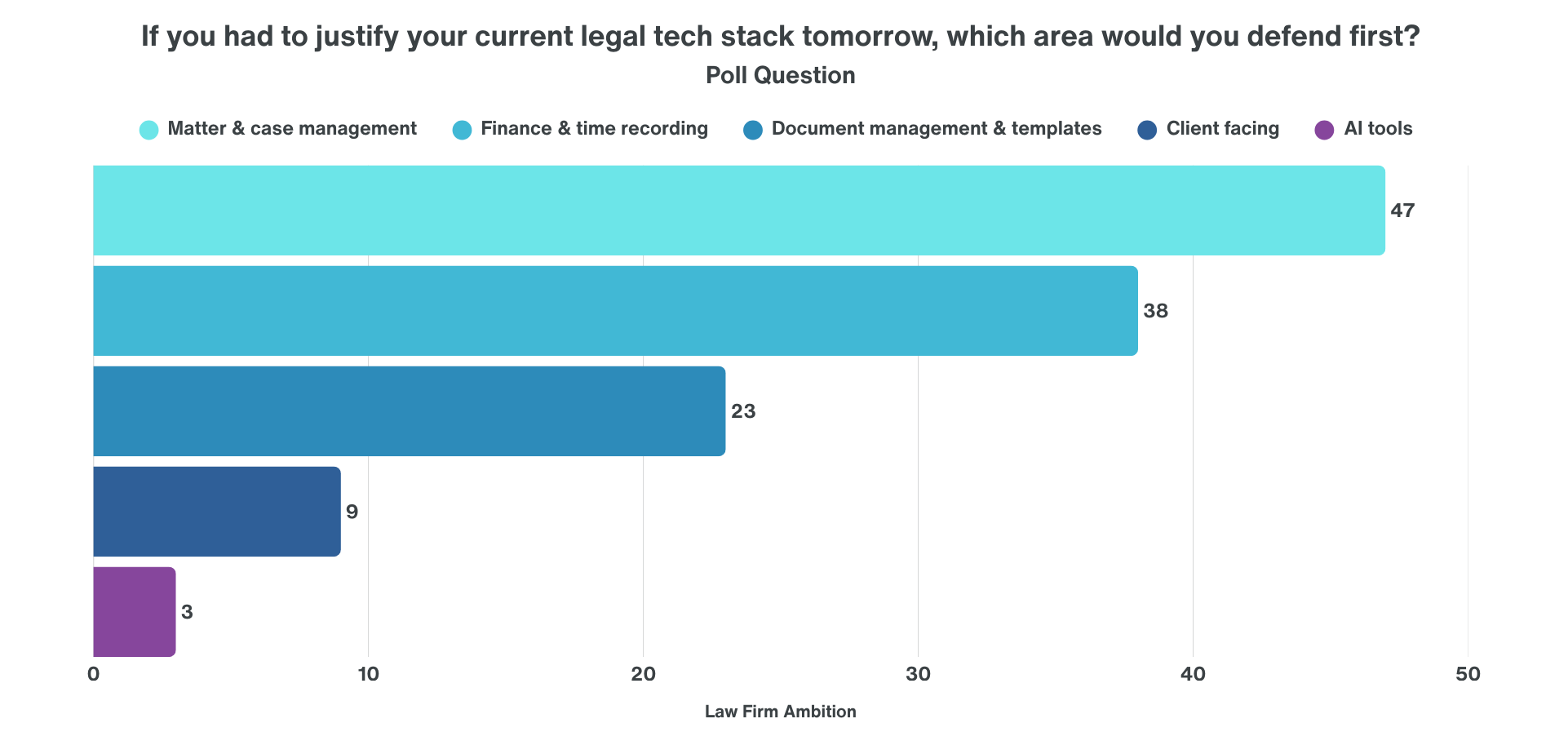
Matter and case management – 47%
Nearly half of respondents identified matter or case management as the backbone of their operations. These systems are central to daily workflows, helping track cases, deadlines, communications, and key documents. Without a robust PMS in this area, firms risk inefficiency, missed deadlines, and compliance issues. It’s no surprise that this is the first system lawyers would defend, everything else depends on it.
Finance and time recording – 38%
The second-highest area was finance and time recording. These systems directly impact a firm’s revenue visibility, ensuring accurate billing, timely invoicing, and effective tracking of client payments. Efficient finance tools also reduce errors and free up lawyers and support staff to focus on client work rather than administrative tasks.
Document management and templates – 23%
Document management remains critical for operational efficiency and compliance. Templates standardise work, reduce mistakes, and streamline communications internally and with clients. For firms juggling high volumes of documents, these tools are essential to maintain quality and consistency across all matters.
Client-facing tools – 9%
While client-facing tools ranked lower, they play a strategic role in improving the client experience. Portals, automated updates, and online communications may not be used every day internally, but they help firms differentiate themselves, particularly as clients increasingly expect digital, frictionless interactions.
AI tools – 3%
AI still represents a small footprint in most firms’ tech stacks, but the impact can be significant. From automating research and document review to providing insights on case trends, AI can improve efficiency and decision-making. Yet this poll highlights that AI is still largely an augmenting tool, not the core of daily operations.
The broader takeaway is that law firms’ technology decisions should be strategic rather than reactive. While AI and new client-facing tools are exciting, the systems that sustain daily operations (case management, finance, and document workflows), remain the real pillars of value. Firms should prioritise investments that align with their operational goals, ensuring technology supports people and processes rather than simply following trends.
People, Processes, and Change Management
Even the most advanced legal technology will fail to deliver value if staff don’t understand it or adopt it effectively. Installing the software is just the first step; true value comes from embedding it into the daily workflows of your staff. Without buy-in, even a powerful system can sit unused or be used incorrectly, undermining the investment and the intended outcomes.
Key strategies for successful adoption include:
Communicate benefits clearly and consistently
People need to understand not only how to use new systems, but why the change matters. Explaining the impact on efficiency, compliance, client service, or workload helps staff see the tangible benefits. Regular updates, reminders, and success stories reinforce the value and keep momentum high.
Employ champions to support adoption
Identify advocates within the firm who are enthusiastic about the new technology and can act as guides for colleagues. These champions bridge the gap between IT teams, vendors, and end-users, helping staff navigate challenges and encouraging consistent use.
Provide proper training and updates to processes
Comprehensive training is essential, and it should go beyond initial onboarding. As software develops or workflows are refined, ongoing training ensures staff stay confident and capable. Updating processes to align with the new technology avoids confusion and prevents old habits from undermining efficiency gains.
It’s also important to recognise that resistance is often about more than just the software itself. Many lawyers and staff have an emotional attachment to older systems, or a sense of nostalgia for the way things “used to work.” Acknowledging these concerns, providing reassurance, and showing the practical advantages of the new system can turn hesitation into engagement.
Successful adoption is a combination of clear communication, support structures, and process alignment. Technology can only deliver its promise when the people using it are equipped, motivated, and confident.
Making Legal Tech Work for Your Firm
The key takeaway from the webinar is that legal technology should help your firm work smarter, not just newer. Technology is a tool, not a magic fix. Start with your strategy, identify the specific problems you want to solve, whether that’s improving efficiency, strengthening compliance, enhancing client experience, or unlocking better insights from your data, and ensure any solution is fully integrated into your people, processes, and workflows. Without this alignment, even the most advanced software will struggle to deliver real value.
Different firms will need different approaches to make tech work effectively. Large firms with complex workflows may require sophisticated integrations across multiple systems to ensure data flows seamlessly, processes are automated where possible, and staff can work without friction. In these cases, the focus is often on connecting case management, finance, time recording, and document management into a cohesive system that supports operational efficiency at scale.
Smaller or boutique firms, on the other hand, can often thrive with simpler, well-integrated systems that focus on the essentials: case management, document management, and client communication. For these firms, success comes from selecting tools that are easy to adopt, fully understood by staff, and aligned with the way the firm operates rather than trying to replicate every feature of a larger platform.
Ultimately, every firm, regardless of size, needs to ask: “What experience do we want for our lawyers and our clients?” Technology should enhance the day-to-day work of lawyers, making processes smoother and more reliable, while simultaneously delivering a better, more responsive experience for clients. By keeping this question front and centre, firms can make intentional, strategic decisions about legal tech, rather than being swayed by the latest trends or vendor promises
With Thanks
We’d like to thank Law Firm Ambition for hosting such an insightful webinar, offering practical guidance on navigating through the world of legal technology, with special thanks to host Andy Poole, and speakers Jane Pritchard, Paul Sams and David Baskerville.
At Cashroom, as founding partners, we are proud to support initiatives that help law firms think strategically about technology, ensuring it delivers real value for both lawyers and clients. Be sure to sign up for our newsletter to receive details about the next Law Firm Ambition webinar in March, which will focus on managing your team, including handling difficult people.
Interested in a confidential chat?
If you are considering outsourcing your legal cashiering, or just want to find out how it works, our team is here to help.