
Proposed client money reforms by the Solicitors Regulation Authority – Key implications for law firms.
A considerable number of changes have been proposed by the SRA, both in the short term and longer term, as part of their consultation on client money in legal services, which could have major implications for law firms.
Since the detailed proposals were released, we have been discussing these with a number of our clients and intermediaries in the legal sector, combining their views with our experiences and thoughts to provide a detailed response to the SRA on the proposals within the context of consumer protection. Whilst we are summarising some of the key takeaways in the following article, please review the full response for a more complete view.
In general, we, and the majority of our clients felt that a lot of the proposed changes are premature and reactionary in the wake of Axiom Ince. In our view, there should be an increased focus on the systems and procedures both within solicitor firms, and the SRA, rather than arbitrary changes which may not suit all types of law equally, nor target the right firms.
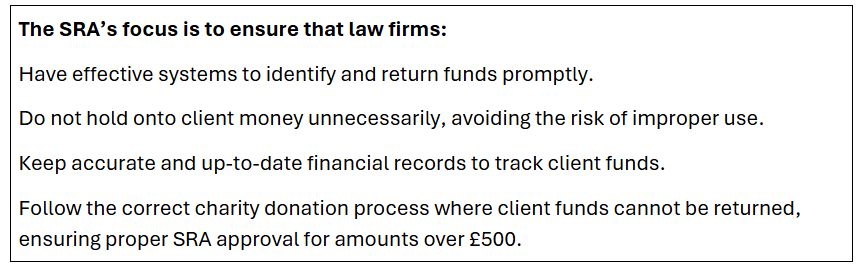
The key proposal within the consultation is the suggestion that firms should no longer hold client money directly, with funds being held by Third Party Managed Accounts (TPMAs). We agree with the consensus that this proposal is extreme and would lead to adverse consequences for consumers such as errors, poor service, and delays to completing transactions. Many argue that this represents a shifting of risk, rather than a reduction. It is also likely that any move to TPMAs would lead to increased costs for consumers, reducing the accessibility and affordability of legal services. It is very difficult to see how such a move would be of any benefit to the end consumer or the sector as a whole. A significant amount of further anecdotal evidence is required before any move to TPMAs can be considered to be a viable alternative to the current model.
The SRA are also proposing to eradicate the ability of law firms to earn interest on client funds. Unless this is creating a widespread issue of firms holding on to funds for too long (of which there is negligible evidence), we believe a more effective solution to ensure that solicitor firms, banks and consumers do not lose out would be for the SRA to provide more detailed guidance on what constitutes a ‘fair rate’ of interest. The SRA could also consider the publication of interest matrixes to foster a consistent approach, as well as possibly bringing interest within the scope of the existing solicitors accounts rules.
The proposed prescriptive rules surrounding advance fees were of concern to our clients, as the ability to request fees and disbursements up front helps to manage risk and to be able to move matters forwards quickly and efficiently in the best interests of their clients. As a result of such changes, firms may need to increase charge out rates to offset the increased risk taken on in these circumstances. Therefore, as long as firms can justify and evidence the fees and disbursements that are requested up front, more prescriptive rules here would not benefit consumers, in fact, it is likely to have the opposite effect.
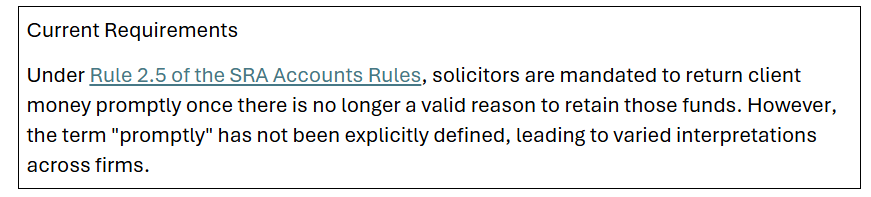
The proposed prescribed timeframe of 12 weeks for returning residual balances shouldn’t, in our opinion, cause too many practical difficulties for firms to implement, provided that appropriate systems and procedures are in place, and the SRA provide clarity on what would be deemed ‘the point of completion’. Our clients felt that the proposed 12 week extension, in difficult cases, would be necessary to avoid unfairly penalising compliant firms.
The focus of these changes should be on how the SRA can improve its own processes to ensure appropriate levels of oversight to identify the non-compliant firms, rather than implementing widespread changes for all. Changes to the Accountant’s Report (AR1) form and MySRA portal could be implemented relatively easily and would be effective at highlighting issues requiring further attention from the SRA. This would focus the efforts of their limited resources towards non-compliant firms. There should also be increased training and support (and possibly qualifications in the longer term) being available for the Compliance Officer for Finance and Administration.
Whilst the above covers only a snippet of the areas covered in our full response, it remains clearly apparent that the majority of the proposed changes within the consultation would not be of benefit to consumers and to the legal market as a whole.
If you would like further advice on this, please do not hesitate to with Kreston Reeves .
For more than accounting, business and wealth advice.
+44 (0)330 124 1399
enquiries@krestonreeves.com
www.krestonreeves.com



 Cashroom









 Can you tell us how Cashroom is supporting this?


 Catherine O’Day, Founder and Non Exec Director





 There was real interest and excitement for the event and on 30th January a group of around 20 of us gathered at






 change will bring. Defining why this change matters and how it will impact the firm sets a solid foundation. For example, if the change involves new technology for case management, explain how it will streamline client onboarding, improve document access, or enhance workflow efficiency. Engaging stakeholders early in the process—such as senior partners and department heads—ensures that key figures are aligned and supportive from the beginning. They can help communicate the vision consistently, reinforcing it across the firm to build understanding and enthusiasm.


 A great starting point is to take stock of your firm’s financial health. Reviewing your performance from 2024 allows you to understand what went well and where


 strengthened the security and accuracy of financial transactions for our clients, reducing fraud risks and ensuring smoother payment workflows for law firms.


 cards, consider tailoring messages to individual clients, acknowledging shared successes or milestones from the past year. Consider gifting clients something thoughtful yet professional. Whether it’s a donation to a charity in their name, a book related to their interests, or a festive treat from a local business, a personal touch reflects your appreciation and can leave a lasting positive impression of your firm.
 bonuses, team recognition awards, or a simple thank-you message from firm leadership, acknowledging the contributions of every member is key to boosting morale. Encouraging your team to take a break from their usual routines by organising a holiday event such as an office party can create a sense of solidarity, helping staff relax and bond in a low-pressure environment.


 But leading on from that- is the work we win good quality? Is there a risk that we are in a sector that has ever decreasing margin? Or is it a sector where a huge amount of very high quality work can be done, but there may be a long tail before billing can happen. Cashflow risks right there!