

Updating Your Legal Technology Strategy
This article was inspired by the recent Law Firm Ambition webinar featuring Stephen Brown, Cathy Kirby and Stuart Whittle.
Technology is changing the way law firms work, but building a successful technology strategy is about more than adopting the latest software or finding a new use for AI. That was one of the key themes of a recent Law Firm Ambition webinar, The Law Firm of Tomorrow: Updating Your Legal Technology Strategy featuring Stephen Brown, Cathy Kirby and Stuart Whittle.
The discussion explored how firms can approach technology strategically, from AI and data management to legacy systems, client expectations, regulation and user adoption. One message came through clearly: technology should support the firm’s wider strategy, rather than becoming the strategy itself.
AI is attracting attention, but it is only part of the picture
AI is understandably dominating conversations about legal technology. During the webinar, lawyers were asked which area of legal technology would be their highest priority over the next 12 months:
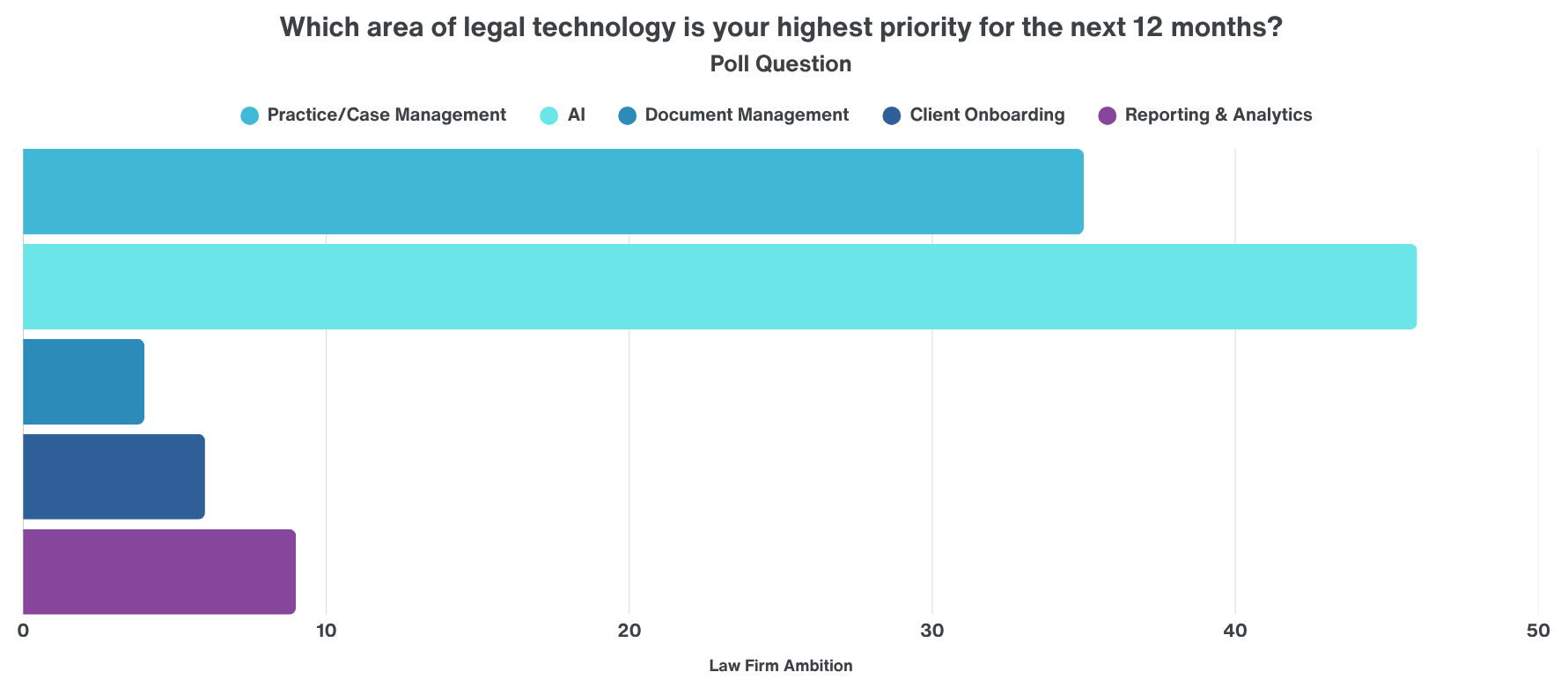
AI’s position at the top is perhaps unsurprising. There is considerable enthusiasm around what it can do, and new applications are appearing fast.
However, the discussion also highlighted a potential risk: assuming AI is the answer before establishing what problem needs to be solved. It can be tempting to look at a new technology and immediately start thinking about how it could be used. A more strategic approach starts somewhere else.
- What is the firm trying to achieve?
- What problem is it trying to solve?
- Where does the firm create value?
- And what specific advantage could the technology provide?
Technology is one part of a wider business strategy. It should have a clear purpose within it.
Regulation needs to form part of the technology strategy
The speed at which technology is developing creates another challenge for law firms. Products are changing quickly, while regulators are increasingly considering the risks associated with AI, data and other emerging technologies. Firms need to think about regulation and compliance alongside innovation. This is relevant regardless of the size of the firm. A smaller firm might assume that changes made by a major technology provider have little relevance to its own strategy. In reality, if Microsoft or another major provider changes how a product works, introduces a new AI capability or removes an existing feature, that change can have a direct impact on the systems a firm relies on.
The pace of change has also altered. Technology decisions that might once have been considered over several years may now need to be reviewed over months. That has implications for IT teams, budgets, training and governance. It also means firms need to think about resilience. What happens if a product is discontinued, acquired or substantially changed? Having a clear technology strategy and governance framework makes it easier to respond when the market changes.
Your clients should influence your technology strategy
Technology decisions should not happen in isolation from the client experience.
Reputation and experience remain the dominant reasons people choose a law firm, but clients increasingly expect to interact with businesses digitally.
That could include:
- Online client onboarding
- Client portals
- Online payments
- Digital document sharing
- Greater visibility over pricing
- Digital communication and updates
The right approach will depend on the firm’s clients and their expectations. A client portal may be extremely useful for one client group, while another may prefer a different way of communicating. The important point is to consider the whole client journey. If clients have different credentials for different systems, have to repeatedly enter the same information or encounter unnecessary friction between stages of their matter, individual pieces of technology may be working well while the overall experience is not.
A technology strategy should therefore ask not only, “What does this system do?” but also, “What does this mean for our clients?”
Start with the process, not the product
One of the recurring themes from the webinar was the importance of understanding existing processes before introducing new technology. It is easy to become excited about a new product, particularly when vendors are demonstrating what it can do. But if the underlying process is unclear, technology may simply make an inefficient process more complicated. Before evaluating a new system, firms should understand:
- What the current process looks like
- Where the problems or delays occur
- What information is being used
- Who is responsible for each stage
- What the desired outcome should be
- How success will be measured
This also highlights the importance of documenting processes. If a process is clearly mapped and understood, it becomes much easier to identify where technology could improve it. It also becomes easier to replace one component in the future without having to rethink the entire workflow. In other words, firms should know what they are trying to improve before deciding what technology they need.
Data needs to be part of the conversation
Many firms have accumulated systems over time, creating different data sources, processes and “data silos”. When systems do not communicate effectively, it can become difficult to obtain a complete picture of the business. This becomes increasingly important as firms look towards AI and analytics. Poor information at the start of a process will not suddenly become good information because it has been put into a sophisticated new system.
Data should be categorised, organised and managed effectively. Firms considering major technology projects should understand what data they hold, where it sits, who can access it and how it moves between systems.
The webinar discussion around legacy systems highlighted the same issue. New technology does not always work seamlessly with older systems, and firms need to consider how their existing technology infrastructure will support their future plans.
The biggest technology project may be getting people to use it
Technology implementation does not end when a new system goes live. In the webinar’s second poll, attendees were asked which technology project had been the most challenging for their firm.
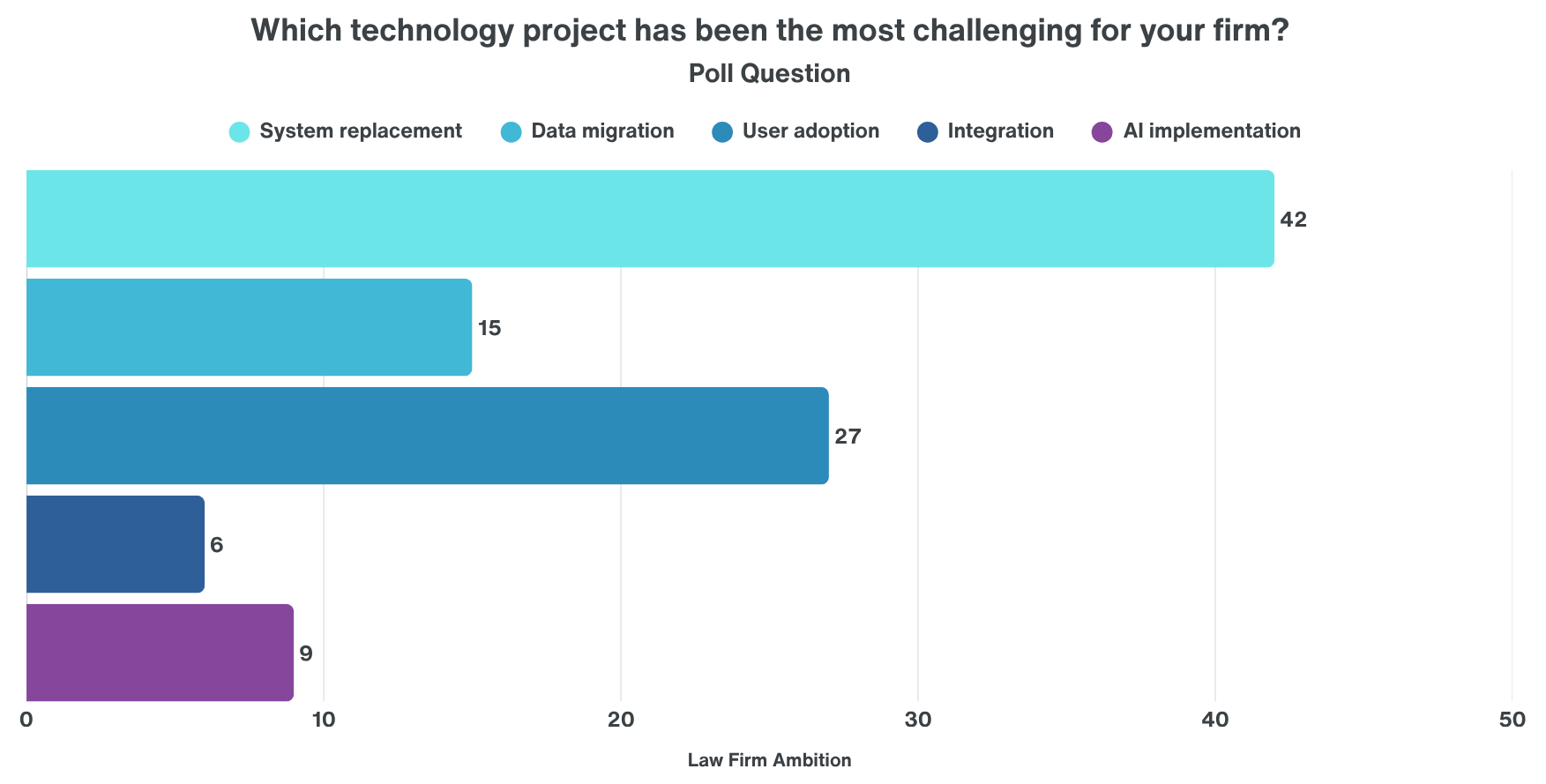
These challenges are closely connected. A new system can be technically successful but still fail to deliver its intended benefits if people do not understand how or why they should use it. User adoption needs to be measured by more than how many people have been moved onto a new system. Firms also need to consider whether people are using it correctly and whether they are getting the intended value from it.
Training cannot be a one-off exercise either. Software changes, new features are introduced and processes evolve. Ongoing training and guidance can help ensure that the firm’s investment continues to deliver value. Most importantly, people need to understand why the change is happening.
Explaining what employees need to do is important. Explaining why they are being asked to do it, and what the benefit will be, is equally important. Technology projects are ultimately people and business projects, supported by IT.
AI governance needs to keep pace
The increasing use of AI also creates new governance considerations. Firms need to think about who is responsible for AI use, what due diligence is required when selecting products, how employees should use AI and how the risks associated with different applications should be managed. This could include clear guidance around:
- Approved AI products
- Data that can and cannot be entered
- Checking AI-generated information
- Recording and sharing effective prompts or processes
- Staff training
- Client communication
- Responsibility and oversight
The risks are not limited to dedicated AI products. Existing software is increasingly incorporating AI features, meaning firms may already be using AI without having specifically considered the implications. I-generated information should also be checked rather than assumed to be accurate. This is particularly important in legal work, where incorrect information can have serious consequences. A technology strategy needs to consider both what AI can do and how its use will be controlled.
Confidence in existing systems remains a concern
Perhaps the clearest indication that firms need to think strategically about their technology came from the webinar’s third poll. Attendees were asked how confident they were that their current systems would support their firm’s growth plans over the next three years.
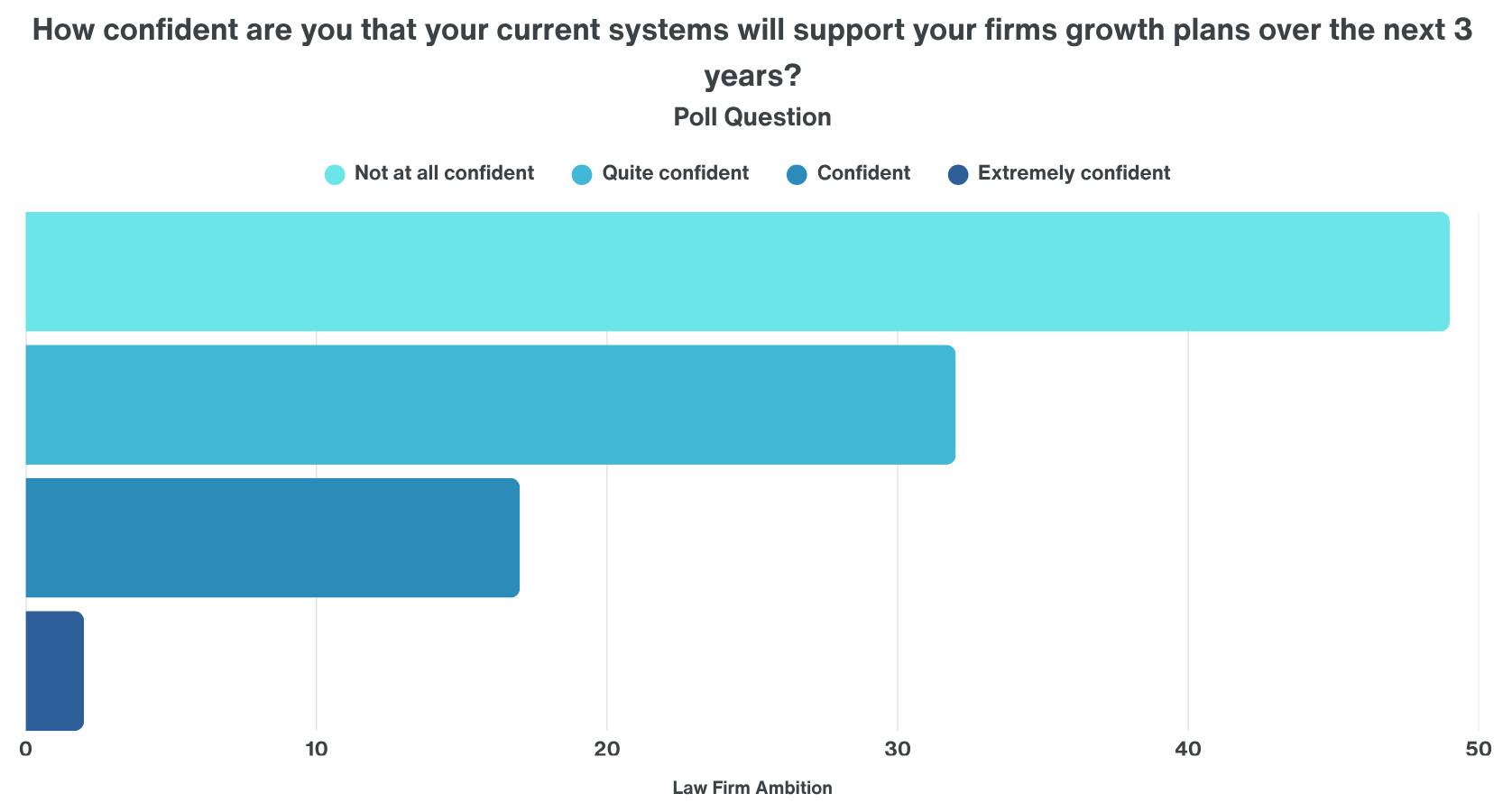
The result reflects a challenge facing many firms: technology debt. Legacy systems can continue to perform an important role, but they can also restrict what a firm is able to do next. At the same time, replacing core systems is rarely a straightforward exercise.
There is a balance to be found between maintaining systems that work today and investing in the infrastructure needed for tomorrow.
The law firm of tomorrow needs a plan for today
The pace of technological change is unlikely to slow down. There will continue to be new AI products, new software integrations and new ways of working. Some will provide genuine value. Others may not solve the problems firms actually have.
The firms best placed to respond will not necessarily be those adopting the most technology. They will be those that understand their business, their clients, their data and their processes well enough to make informed decisions about where technology can help. That means having a clear plan. Before introducing a new system or AI application, firms should be able to answer:
- What problem are we trying to solve?
- How does this support our wider business strategy?
- What will it mean for our clients?
- What data will it use?
- What are the regulatory and security considerations?
- How will we train our people?
- How will we measure whether it has worked?
- And perhaps most importantly:
- What happens if the technology changes or disappears?
The law firm of tomorrow will certainly use technology differently from the law firm of today. But successful technology strategy is not about chasing every new development. It is about making deliberate choices that support the firm’s people, processes, clients and long-term objectives.
For law firms reviewing their technology strategy, getting the foundations right including clear processes, effective data management and well-defined financial workflows, can be just as important as deciding which new technology to adopt.
Don’t miss the next webinar from Law Firm Ambition, ‘Pricing and project management, the winning combination’ on Thursday 26th November at 9.30am. Register here
Early bird tickets are now available for the Law Firm Ambition Annual Conference 2027
Join industry experts in Leeds for a day of practical insights, thought-provoking discussions and valuable networking, with a focus on helping law firms achieve sustainable growth and long-term success.