

Why we all need to learn the Charleston
The last article I wrote for the blog sounded an upbeat note for 2021, comparing the 2020s to the “roaring” 1920s. Since then we’ve a new strain of the virus, chaos at Dover, and the continuing Brexit drama, with no deal in sight.
All looking a bit bleak again.
However, some more thoughts to try and keep us smiling over the festive period.
Part of the reason for my optimism was clients reporting that there was a “lot of cash looking for a home”. Well, I’ve been looking at that a little bit more.
 According to Refinitiv, 2020 has been a bumper year for raising finance. Initially, much of the money raised was “defensive” in nature (in April Carnival Cruise Lines raised $6.25b in debt, and Boeing sold $25b in bonds around the same time), however by the summer more business were raising finance presumably because they saw opportunity. The cash now held by non-financial firms is around $7.6t, up from $5.7t last year.
That’s an awful lot of “cash looking for a home”! Where will it find that home?
Bluntly, I have no idea, but there is one thing that’s clear – the pandemic, and the various lockdowns have driven innovation. Business have been forced to change dramatically, and people are beginning to realise that the things they thought would be “too hard” or would take too long are actually a lot easier than they thought. Change and innovation isn’t as difficult as we all thought.
So, we have a situation where businesses have lots of cash and are less fearful of new ideas and change….! I suspect some of that cash may “find a home” in technology and innovation investments!
And there’s something else.
Productivity is the engine of growth and prosperity. Doing more with less drives increases in income and living standards. However, since the financial crisis productivity in the western world has remained pretty static.
 Economists debate why that is. However, one theory is that it takes time to work out how best to deploy new technologies effectively. Think about the “dot com boom” – everybody knew that the internet would revolutionise the world … but it took a while to work out how that would happen – hence the dot com bust. It takes time for businesses to work out how best to use technology and make the organisational changes that let them do it.
Well, the pandemic has forced our hand. There has been more organisational change, and technological innovation in the last year than many people expected in the next 5 years.
Now combine that, with all the “cash looking for a home’ and it makes you wonder if we are looking at a productivity boom in the 2020’s…..!
The more I think about it, the more I can see reason to be optimistic … and the more I want to learn the Charleston!
David Calder, Managing Director
 Lexcel encourages law firms to adopts strict controls (
 Paul McCuskey is Managing Director of
 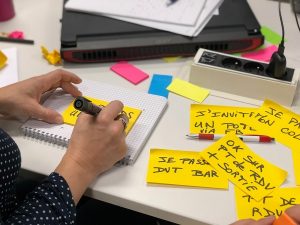 She now keeps password details on yellow stickers next to her screen. [Clear security risk, but surprisingly common] The new system is cloud based and many data reports are available, however Maureen tends to provide info to the partners using Excel spreadsheets. It can take several weeks to pull the data into her old spreadsheets but she prefers to do it that way. [Inefficient process and providing the Management Information to the partners so slowly makes the information far less useful]
 This year the firm has of course coped with Covid restrictions. Initially their work dropped off, but there has been a huge surge of conveyancing work since July. When the first lockdown occurred, Maureen was sent to work from home, however the firm’s technology and processes didn’t work for her. Her home wifi kept crashing as she tried to set up payments. The partners who were used to giving her tasks face to face struggled to implement remote working. Supervision and ongoing training of Joe was almost impossible. When things eased the firm decided to move the finance function back into the office, seating Joe and Maureen at either end of their room. [Many firms had the same problem- working securely and efficiently away from the office is not as easy as simply sending people home with a laptop]
 My first take away, was how resilient our client firms are. While a few found the first lock down, challenging, all of them managed, with a mixture of home working, and minimising visits to the office.
 As I mentioned above, residential conveyancing lawyers are nervous. There is normally a dip over the holiday period, but the expectation is that with increasingly sever lockdowns, and the expectation of increased redundancies, that will be exacerbated (one person referred to the Furlough Scheme as the “Redundancy Deferral Scheme”!). A number of people reported mortgage lenders dramatically tightening their lending criteria, making getting a mortgage much harder.
 The biggest problem for individuals and business over the last few months has been uncertainty and a collapse in confidence. Everybody has put off significant purchases and investments because of uncertainty, and a lack of confidence. The result – a lot of people are sitting on cash – remember the firms who have their CBILS still sitting in the bank, and all that cash “looking for a home”?
 There is no doubt that there is an increase in cyber awareness and firms are training
 I promise I didn’t spend my honeymoon in Cornwall thinking about the legal sector and business generally. That would be tragic, and may well be the sort of thing that would lead to a very brief marriage.
 When we were looking where to eat we would want to view a clear website, with the detail we needed (menus usually, and lists of cocktails!), and we would always consider some of the recent reviews and star ratings.
 It is easy to see how much cash you have in the bank from month to month, but much more difficult to monitor how much your clients owe you, how much you owe creditors, and of the monthly movements in those figures. An increase in debtors, without an increase in turnover can be an early warning sign that clients are taking longer to pay, and that you need to invest some time in chasing payment of your outstanding fees, or using an outsourced Credit Control service.
 Some business owners will choose to take their earnings in dividends or drawings rather than salary. However, for less established or less profitable companies this will need careful monitoring, to ensure too many dividends or drawings are not taken through the year. For other businesses, it may be that through monthly monitoring, it is perfectly possible to take more drawings each month.
 Every limited company must file a set of accounts with
  If you are looking to raise finance from a bank or investor, continue or increase an overdraft, usually a good business plan, backed up by forecasts and accounts, can dramatically improve your chances of success. However, this can be difficult to do if you are using a set of accounts that were produced 6 months or more ago. This is especially true if the business performance has changed significantly since the last financial year end, or in the present situation, where the whole world has changed significantly since the previous year!
 So we are now well into lockdown 2 in England but hopefully it is not quite as drastic on working life as the first time – thankfully there is less home schooling, banana bread making and Joe Wicks too! Wales has come out of their ‘circuit break’ and the central belt of Scotland is working under Tier 3 restrictions. Back in March, EVERYTHING stopped so what about this time?
 We had planned to reopen in October, but have recently told our staff not to expect to be back working “in person” until April next year. Pessimistic? Perhaps, but one thing that makes lockdown harder is uncertainty. How do you plan your life, if you don’t know from one month to the next whether you will be at home of in the office? By ruling out a return to the office for 6 months, it lets people plan a little bit further ahead.
 So, like many people I’m going into my 8th month of working from my “study” at home. And when I say “study”, I really mean the kids old “playroom”, complete with pictures on the wall and Winnie the Pooh lamp shade!
 CSR activities, at any time, really can be a win:win:win!
 So, I would encourage you not to write off CSR just now, but to embrace the opportunities it brings.
 Asking a lawyer whether they know what they are doing might seem a little odd. Not an approach likely to endear me to lawyers in general! However, having been a lawyer some years ago, and a partner at a couple of large law firms, I do know that it’s a valid question.
 It is frequently an area of the firm which the lawyers do not understand. Cashiering is a dark art which requires significant expertise, and even more so as it now interacts with the technology utilised by the firm. The practice management system, so often seen by the lawyers as simply a case management tool, carries the accounts element which, both for compliance and risk avoidance, must be operated efficiently and accurately.
 That must bring a smile to the face of commercial landlords. If somebody is prepared to make that sort of investment into the retail sector, and into a business that has such a massive retail “footprint”, maybe it’s not all “doom and gloom”.
 But what about the huge Asda mega stores. There’s one not far from where I live, and it’s cavernous. But again, a move away from “traditional retail” may be on the cards.
 Having a clear set of values can really help direct the culture in your business. Think about what is important, what are the principles you want to drive your business – teamwork, trust, fun and innovation are popular themes in company values. We already have company values but we are taking this time to look at them again – does everyone understand them? How do we communicate them more effectively? How do we integrate our values into part of our everyday work?
 Take time to learn about everyone. In an office you get a sense of who people are, without even trying. This is hard remotely as you aren’t sitting chatting in the kitchen or at the printer. Something we are doing is sending short virtual surveys out to staff with a few short questions, favourite tv programme, do they do sports, role in the company and we’re publishing these. We hope these generate some conversation which will really help grow a positive company culture.
 Today I dropped my daughter off at the local train station. We live in a smallish town within commuting distance of Edinburgh. “Normally” the station carparks are chaos, with all spaces full, and people resorting to leaving their cars on the grass verge. This morning (at about 0830), it was empty … well not empty, but there were far, far fewer cars.
 At the Cashroom, the biggest downside is our staff miss the social interaction of the office. They miss the chat, and they miss their friends. The biggest challenge for us (and I would suggest all firms contemplating long term working from home, or a blend of home and office), is how do we address that?